How to Set Up a Complete CCTV System for Your Business

Comparison: Hikvision, Dahua, Uniview and UniFi
In 2026, business customers expect more from their security than ever before. A professional camera system has to be reliable, smart, scalable and affordable. Whether you want to secure an office, a shop, a warehouse or an entire business park, choosing the right system is essential.
In this article we explain what a professional camera system consists of, which technical points deserve your attention, and how the most popular brands – Hikvision, Dahua, Uniview and UniFi – compare.
What does a complete business CCTV system include?
A modern camera system for business use consists of:
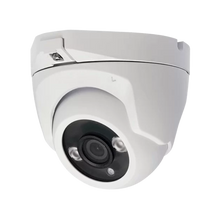
- IP cameras (indoor/outdoor, fixed or PTZ)
- A network video recorder (NVR) with a hard drive for storage
- Cabling and PoE switches for power and data
- Access via software or an app (live view, playback, notifications)
- Optional: integration with an alarm system, access control or a VMS
Technical considerations for businesses
Business users have higher requirements than home installations. Pay attention to:
- Resolution: at least 2 MP, but 4 MP to 4K is recommended for recognising details.
- Night vision: infrared (IR) up to 50 m, or colour images in low light (ColorVu/Starlight).
- AI features: motion detection, vehicle and person recognition, line crossing.
- PoE: Power over Ethernet is ideal for a stable power supply over network cables.
- Storage capacity: depends on the number of cameras and the retention period; 2 TB to 12 TB is typical.
- Software: choose a user-friendly system that suits the way you want to manage it.
Brands compared: Hikvision, Dahua, Uniview and UniFi
Most businesses today choose one of these four manufacturers. Below is a detailed comparison of their strengths, applications and technical features.
Hikvision: the market leader in high-end video surveillance
Pros:
- The largest range of cameras, recorders and AI solutions in the world.
- Excellent image quality up to 4K, with thermal and panoramic options.
- Advanced AI (DeepinView, AcuSense) for person and vehicle recognition.
- Integrates flexibly with VMS platforms, alarm systems and intercoms.
- Powerful software (Hik-Connect, iVMS-4200, HikCentral).
Cons:
- Installation gets more complex when you use the advanced features.
- Higher price than entry-level brands.
Ideal for:
Businesses with demanding security requirements, such as distribution centres, office buildings, industrial sites and government applications. Hikvision is the go-to choice if you want maximum intelligence, scalability and reliability.
Dahua: innovative and versatile
Pros:
- A broad portfolio with strong mid-range solutions.
- Innovations such as WizSense, ColorVu and Smart Motion Detection.
- An intuitive app (DMSS) and a clear NVR interface.
- Good value for money.
- Suitable for both IP and coax-based systems.
Cons:
- Some AI features require more expensive models.
- Its VMS is less extensive than Hikvision's, but sufficient for most applications.
Ideal for:
Shops, schools, restaurants and bars, offices and businesses looking for plenty of value for their money. Dahua offers stable performance and modern technology without the premium price tag.
Uniview: solid performance and efficient storage
Pros:
- Robust hardware with sharp image quality.
- Ultra265 compression saves storage space and bandwidth.
- Easy installation and management via the EZView app and NVMS software.
- Suitable for budget-conscious projects without compromising on stability.
Cons:
- A less familiar brand outside the professional installer community.
- AI features are more limited than those of Hikvision and Dahua.
Ideal for:
SMEs, warehouses, retail and projects where stability and cost efficiency matter. Uniview is particularly strong in the mid-range segment of the market.
UniFi (Ubiquiti): modern, sleek and fully integrated
Pros:
- Attractive design that fits modern offices and showrooms.
- UniFi Protect software is intuitive and free to use.
- Seamless integration with existing UniFi network infrastructure.
- Works without the cloud: footage is stored locally on UniFi NVRs.
Cons:
- A smaller camera range than the other brands.
- Not suitable for larger or complex security environments.
- No in-depth AI features like those of Hikvision or Dahua.
Ideal for:
Small to medium-sized offices, IT-driven businesses and users who prioritise simplicity, design and IT integration. UniFi is user-friendly and ideal if you already run a Ubiquiti network.
Comparison at a glance
| Brand | Pros | Cons | Best suited for |
|---|---|---|---|
| Hikvision | High-end AI, broad compatibility | More complex to manage | Large enterprises, government, distribution |
| Dahua | Affordable, versatile, AI available | Advanced features require more expensive models | SMEs, retail, hospitality |
| Uniview | Efficient, stable, budget-friendly | Less well known, limited AI | Warehouses, SMEs |
| UniFi | Design, simplicity, integrated system | Limited range, not for large installations | IT offices, tech companies, home offices |
Conclusion: choose the right brand with guidance from UMATECH
Choosing a camera system is always a tailored decision. Location, budget, scalability, technical requirements and ease of use all play a role. Each of the four leading brands has its own strengths:
- Hikvision: suited to complex, intelligent and large-scale solutions.
- Dahua: widely applicable, with an excellent balance between price and technology.
- Uniview: stable, affordable and reliable for mid-sized systems.
- UniFi: attractive and intuitive, with seamless network integration.
- At UMATECH we support you through the entire process, from advice and design to delivery and support. We only supply professional brands and systems that have proven their worth in the business market.
Want to know which system suits your office, shop or business premises? Get in touch with our team – no obligation.