Outdoor Security Cameras – What to Look For (IP Rating, Night Vision, Field of View)

An outdoor security camera keeps an eye on your yard, driveway or business premises, day and night. When choosing one, three things matter most: the IP rating (weather resistance), night vision and the field of view. In this guide we go through each of these points, so you can choose an outdoor camera that suits your situation.
What do you use an outdoor security camera for?
An outdoor security camera acts as a deterrent and records what happens at your front door, driveway, garden or premises. You use it to discourage burglars, identify parcel thieves or keep an overview of a business site. You'll find our full range in the video surveillance collection.
IP rating: built to withstand the weather
An outdoor camera has to withstand rain, dust and frost. You can tell how well it does from the IP rating. Choose at least IP66: the camera is then dust-tight and protected against powerful water jets. IP67 can even handle temporary immersion. In locations where vandalism is a risk, also check the IK rating, which indicates impact resistance. An outdoor IP camera with a good IP rating will last for years without moisture problems.
Night vision: infrared or colour
A lot happens after dark, so night vision is important. There are two types. Infrared (IR) gives a sharp black-and-white image up to several tens of metres away, even in complete darkness. Colour night vision uses a highly sensitive sensor and sometimes a small spotlight, so you see colour at night. Colour helps you identify clothing or a car. When choosing, check the specified range in metres.
Field of view and resolution
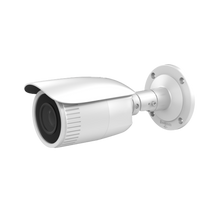
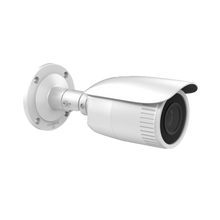
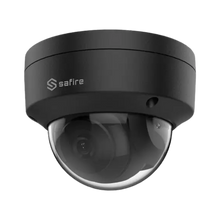
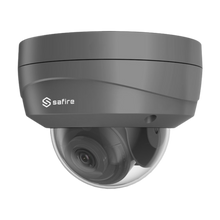
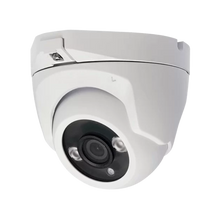
The field of view determines how much you see, the resolution how sharp it is. A wide angle covers an entire driveway; a narrower angle sees further but covers less width. For most situations, 4 MP offers a good balance between detail and storage space. If you want to recognise a face or licence plate at a distance, choose more megapixels or a camera with a zoom lens. Also consider the camera type: our article on the difference between dome, turret and bullet cameras explains which one suits which situation.
PoE or Wi-Fi, and camera placement
A wired IP camera with PoE receives power and data over a single network cable and is the most stable option for continuous recording. Wi-Fi is easier to install, but more susceptible to weak signals outdoors. Mount cameras high enough that they can't be turned away or covered up, don't point them straight into bright backlight, and cover the main walking routes. For a PoE camera, you run a network cable to your switch.
Common mistakes
The most common mistakes: mounting a camera so high that you only see the tops of people's heads, pointing it straight into the sun so the image is overexposed, using an indoor model outdoors, or filming too much of the public road. Map out the walking routes in advance and choose the field of view accordingly. That way you get usable footage instead of vague silhouettes.
Which cameras and kits are a good fit?
If you want a complete system in one go, take a look at our camera kits, which bundle cameras and a recorder in one package. You'll find individual cameras and recorders in the video surveillance collection. Not sure how many cameras or which type you need? Send us a description of your situation via WhatsApp and we'll help you work it out.
Frequently asked questions
What is the difference between PoE and Wi-Fi for an outdoor camera?
PoE carries power and data over a single network cable and is the most stable option for continuous outdoor recording. Wi-Fi is easier to install because you don't need to run a cable, but it is more susceptible to a weak or disrupted signal. For reliable video surveillance of larger premises, we usually choose PoE.
How many cameras do I need?
That depends on what you want to see. Plan one camera per important walking route or corner, for example the front door, driveway and back garden. For an average home, you'll often end up with two to four cameras. Not sure? Send us your situation via WhatsApp and we'll advise on the right number and placement.
Where can I place an outdoor security camera under the GDPR (AVG)?
In the Netherlands you may film your own home and property, but keep the public road and your neighbours' garden out of view as much as possible. Use the field of view or a privacy mask to record only your own property, and make it clear that cameras are in use. That way you stay within the privacy rules.
What IP rating do I need for outdoor use?
Choose at least IP66: the camera is then dust-tight and protected against powerful water jets, which is enough for Dutch rain. IP67 can even handle temporary immersion. In locations where vandalism is a risk, also check the IK rating for impact resistance. A good IP rating prevents moisture problems in the long run.
Does an outdoor security camera work without internet?
Yes, a camera with a recorder (NVR) records locally, even without internet. If you want notifications on your phone or to view footage remotely, you do need an internet connection. So choose based on whether you only want to record or also want to view remotely.
How do I get good night vision outdoors?
Choose a camera with enough IR range in metres for your distance, or a model with colour night vision and a small spotlight. Avoid bright backlight and reflective surfaces right in front of the lens, as they disrupt the night image. That way you keep a usable, sharp image even in the dark.